










Customer Checkout

Your customer enters their payment details at checkout, on an invoice link, in the virtual terminal or at a terminal in your store.

A modern payment gateway that helps businesses accept credit cards, ACH eChecks and digital wallets online, in store and on the go. Interchange optimization runs on every transaction, so eligible sales can qualify for better rates.
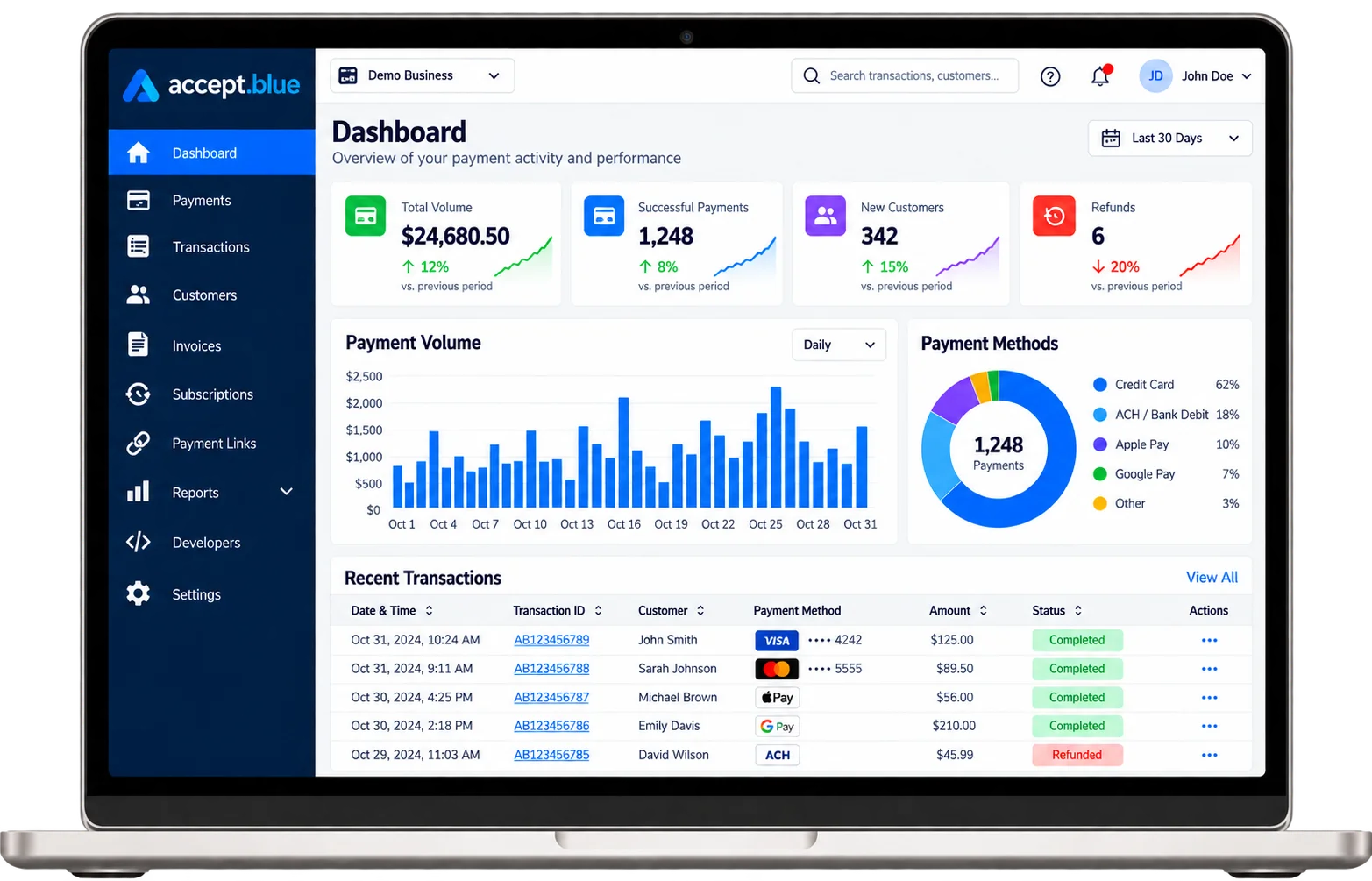
Support all major credit cards, ACH eCheck and popular digital wallets.







One gateway. Every channel.
Everything you need to run your business and get paid.

Send Level 2 and Level 3 data automatically so eligible transactions can qualify for lower interchange rates.

Key in phone, mail and B2B payments from a browser, with card and check options on one screen.

Set the billing schedule once and accept.blue runs the scheduled payments for you.

Screen transactions with ten configurable fraud modules, risk scoring, AVS and CVV rules and 3D Secure support.

Store customer records and payment methods as tokens so repeat and recurring sales run without re-entering card data.

Send branded invoices by email or text with automated reminders and a secure payment link.
accept.blue connects to the platforms you already run on and gives developers a clean API, hosted tokenization and a sandbox account.
Your customer enters their payment details at checkout, on an invoice link, in the virtual terminal or at a terminal in your store.
accept.blue tokenizes the payment details, adds Level 2 and Level 3 data where it applies, runs your fraud rules and sends the transaction on to your processor and the issuing bank.
The bank approves the transaction and the funds are authorized.
Funds settle to your merchant account on your scheduled funding cycle.

accept.blue gives you the flexibility to connect your merchant account to your website, shopping cart, invoicing tools or custom checkout, and to run every channel through one gateway account.

From startups to enterprise, accept.blue scales with you.

Seamless online payments for your store.

Accept chip, tap and mobile wallet payments at the counter with integrated EMV terminals.

Run recurring billing and memberships on stored card tokens.

Take phone, mail and invoice payments through the virtual terminal.


The accept.blue payment gateway is a PCI Level 1 compliant gateway that connects a website, software, virtual terminal or Equinox EMV terminal to a merchant account and card processor. accept.blue authorizes all major credit cards, signature debit cards, eChecks and ACH payments online, by phone and in person, and builds Level 2 and Level 3 interchange optimization into the platform.
accept.blue is a payment gateway, not a merchant account. The gateway authorizes and routes transactions, while funds settle to a separate merchant account approved by an acquiring bank. accept.blue is offered through ISOs and resellers, so a business looking for an accept.blue merchant account needs a provider for the account itself. AllayPay sets up the merchant account and connects it
to accept.blue.
accept.blue supports all major credit cards, signature debit cards, eChecks and ACH payments. accept.blue also supports Google Pay, Apple lists accept.blue as a supported Apple Pay payment platform in the United States, and accept.blue added cash processing as a supported payment method in 2025. Digital wallet availability depends on the integration the merchant uses.
Yes. accept.blue offers Hosted Tokenization, hosted payment pages, pay links, shopping cart plugins and a developer API. Merchants can choose a simple hosted option or build a custom checkout.
Yes. accept.blue lists integrations with Shopify, WooCommerce, Magento, OpenCart, Foxy, Salesforce, Zoho CRM, NetSuite, Acumatica, Microsoft Dynamics, Sage 100 and Odoo, and connects to QuickBooks through partners such as Hyfin and Biller Genie. accept.blue built the Shopify, WooCommerce, Magento, Salesforce, Zoho CRM and NetSuite plugins itself, while Bluemoon ISV and Erisana maintain the Acumatica, Dynamics and Sage 100 connections. Any other accept.blue gateway integration runs through the developer API.
Yes. The accept.blue Virtual Terminal lets authorized users process card and check payments from a browser. It supports phone orders, mail orders, invoices and other payments where the customer is not completing an online checkout.
Yes. Merchants can build subscriptions and scheduled payments inside the virtual terminal, with several timing options. Pair it with the Customer Vault so stored payment methods rebill without collecting card data again.
Yes. The Secure Customer Vault stores customer records along with multiple payment methods, and the sensitive data is tokenized. Merchants can reuse a stored method for repeat sales and recurring billing.
Hosted Tokenization places an iFrame of payment fields on a merchant website or inside their software. accept.blue hosts those fields, which lowers PCI scope while the checkout design and user experience stay the same.
Yes. The built-in invoicing suite sends invoices by email or text message. Invoices carry the merchant logo and company details, support automated reminders before and after the due date, capture an electronic signature at payment and collect payment through a secure link.
Yes. The virtual terminal has a built-in surcharge feature that applies a surcharge or convenience fee automatically. Merchants can set it as a percentage or a fixed dollar amount, and can apply different fees to card payments and check payments. It also offers dual pricing on hosted payment pages. Surcharging rules vary by state and card brand, so review the rules that apply to your business.
Yes. Check processing is built into the accept.blue virtual terminal, and accept.blue is integrated with ACH processors including Paya, VeriCheck, Maverick Payments and Unity Fi Solutions, which accept.blue added in 2025. ACH access depends on underwriting approval and account configuration.
accept.blue interchange optimization sends extra transaction detail, known as Level 2 and Level 3 data, so eligible business and government card transactions can qualify for lower interchange categories. accept.blue calls this its specialty and builds the process into the platform, so merchants do not key in the extra data by hand.
Yes. accept.blue updated its Level 2 and Level 3 processing in 2025 to meet Visa’s Commercial Enhanced Data Program (CEDP) requirements. Visa CEDP replaced the U.S. Level 3 program on October 18, 2025, and Visa scheduled the end of its Level 2 interchange program for April 2026. Visa commercial card sales now need line-item Level 3 data to earn the lower rates, and blank, zero or filler fields disqualify a transaction.
accept.blue includes ten fraud modules with extensive customization. Merchants can block transactions by amount, email address, IP address and domain, set a preferred risk score and customize AVS and CVV responses. accept.blue also supports 3D Secure through its PAAY partnership, which accept.blue says helps reduce friendly-fraud chargebacks and false declines. For high-risk accounts, AllayPay also offers chargeback monitoring services.
accept.blue describes its gateway as PCI Level 1 compliant and offers tokenization, a secure vault and hosted payment fields that cut the amount of card data a business handles. Merchants must still complete the PCI requirements that apply to their own payment environment.
Yes. accept.blue integrates Equinox EMV terminals for card-present payments, so in-store sales run through the same gateway account as online transactions.
accept.blue is certified to major card processors including Fiserv, TSYS (now Global Payments) and Elavon. The gateway is processor agnostic, so the merchant account can sit with the platform that fits the business.
Yes. Authorized users can refund settled transactions and void eligible transactions before settlement. These actions run through the gateway and through supported API and plugin integrations.
Yes. accept.blue provides a developer API with published v2 documentation, the Hosted Tokenization iFrame and sandbox test accounts for developers, ISOs and software companies. Developers request a sandbox account through the accept.blue support contact form.
accept.blue supports enterprise workflows through its API, ERP plugins for NetSuite, Acumatica, Sage 100 and three Microsoft Dynamics editions (365 Business Central, GP and 365 Finance and Operations), automatic Level 2 and Level 3 optimization, batch upload, invoicing and recurring billing. The Level 2 and Level 3 savings apply to business, corporate, purchasing and government cards, so B2B sellers gain the most.
Yes. The accept.blue payment gateway can run high-risk transactions when the merchant account behind it is approved for that industry. accept.blue integrates with Konnektive, a CRM that accept.blue says supports high-, medium- and low-risk industries, and with the Checkout Champ subscription platform. AllayPay specializes in high-risk merchant accounts for industries such as CBD and Delta 8, nutraceuticals, research peptides, vape, firearms, credit repair and travel.
accept.blue does not publish merchant pricing. accept.blue is offered through ISOs and resellers, so the gateway fee, per-transaction fee and any ACH or add-on fees are quoted by the merchant service provider. To see what accept.blue would cost for your business, request a free quote from AllayPay.
The main difference between accept.blue and Authorize.net is how each gateway is sold. Authorize.net, a Visa company, sells its gateway directly to merchants under its own brand, while accept.blue is offered through ISOs and resellers as a full white-label gateway. accept.blue also builds automatic Level 2 and Level 3 optimization into the platform. AllayPay offers Authorize.net directly.
AllayPay provides the merchant account an accept.blue gateway connects to, with a focus on high-risk and hard-to-place industries. AllayPay, Inc. has operated from Plantation, Florida since 2016, serves more than 1,000 active merchants, processes over $1.1 billion a year and includes a dedicated U.S.- based account manager. AllayPay also offers Authorize.net, NMI and Fluid Pay directly when a different gateway fits better.
Getting started with accept.blue through AllayPay begins with a free quote request listing your business type, website, monthly volume and average ticket. AllayPay offers same-day approvals for many businesses, then configures accept.blue for the approved online checkout, virtual terminal, ACH, invoicing, recurring billing or in-person payment workflow. AllayPay boards U.S. merchants only.
Get Started
Tell us about your business and we'll match you with the right banking partner and the right pricing, usually within one business day.
 No long-term contracts. Cancel anytime.
Service and support at a fraction of the cost.
Dedicated U.S.-based account manager included.


