










Customer Checkout

Your customer pays through your checkout page, a payment link or your team's virtual terminal.

A B2B payment gateway that helps businesses accept credit cards and ACH payments online, in person and on the go.
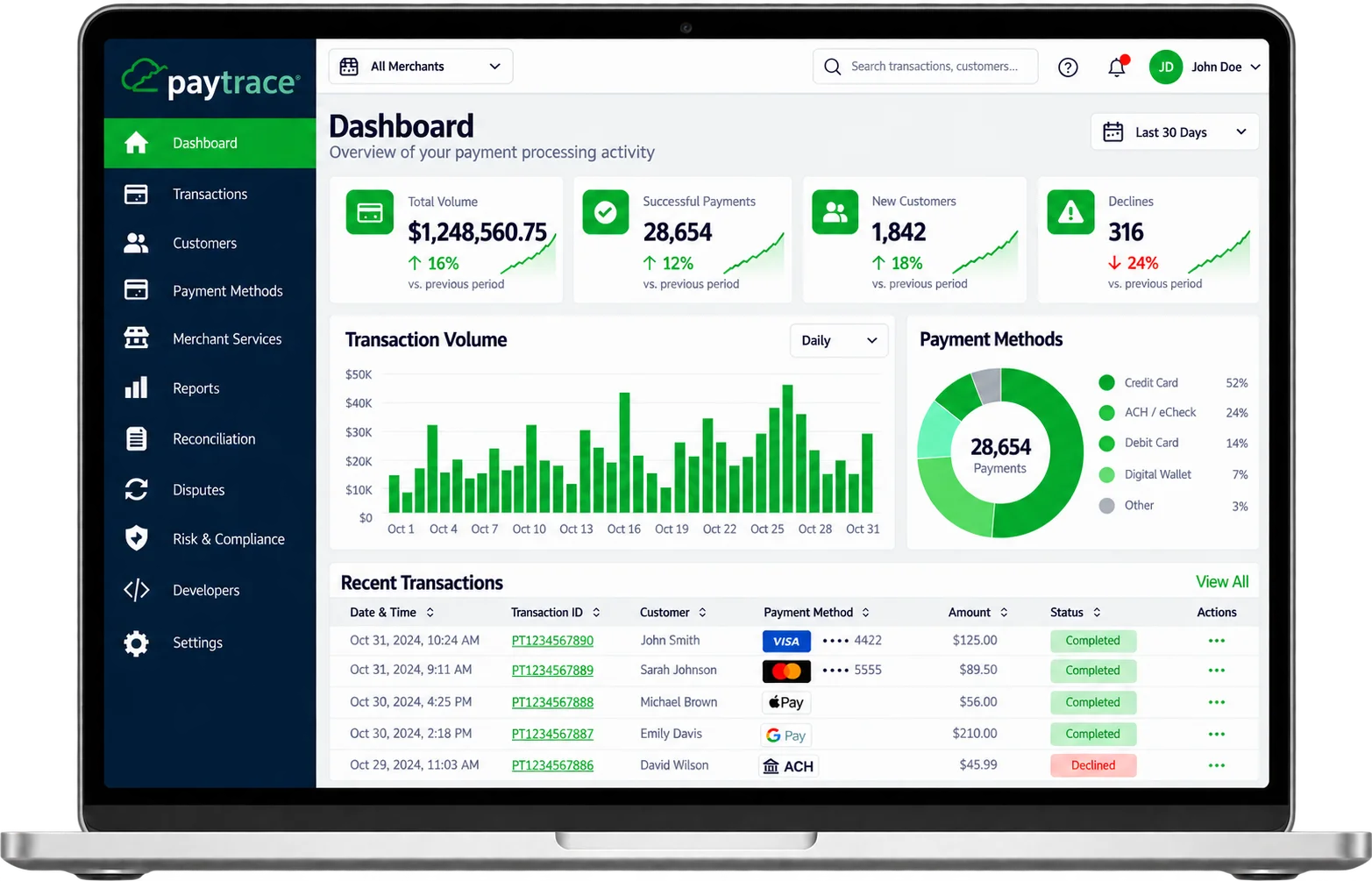
Support major credit cards, ACH and eCheck payments.





Built for B2B. Connected to your ERP.
Everything you need to run your business and get paid.

Schedule recurring payments from saved customer profiles, with Level III data when needed.

Enter card and ACH payments by hand in a secure, browser-based terminal.

Reduce risk with custom fraud detection tools and a PCI DSS compliant platform.

Store customer payment details as tokens for faster repeat and recurring billing.

Qualify eligible B2B and government sales for lower interchange rates with automated Level II and III data.

Email invoices with secure payment links and sync transaction reports with your accounting software.
PayTrace connects with leading ERP and eCommerce platforms and offers a JSON API with free sandbox testing.
Your customer pays through your checkout page, a payment link or your team's virtual terminal.
PayTrace encrypts the payment data and submits the transaction to the issuing bank.
The bank approves the transaction and the funds are authorized.
PayTrace settles pending transactions each night, and funds move to your merchant account.

PayTrace lets you connect your merchant account to your website, ERP, accounting software or virtual terminal while you accept card and ACH payments securely.

From growing teams to large B2B suppliers, PayTrace scales with you.

Accept online B2B and B2C payments through hosted fields, Pay Now buttons and cart plugins.

Lower card costs on large orders with Level II and III data for manufacturers and distributors.

Bill clients on a set schedule with recurring payments and saved customer profiles.

Take phone, mail and invoice payments through the virtual terminal and payment links.


PayTrace is a B2B payment gateway that connects your website, software, virtual terminal or payment device to your merchant account. It supports online, in-person and manually entered card and ACH payments. PayTrace was founded in 2004 in Spokane, Washington, and is now part of North.
PayTrace is both a payment gateway and a merchant service provider. A PayTrace merchant account comes through PayTrace Merchant Services, which bundles the account, gateway and accounts receivable tools under PayTrace’s parent company, North. Businesses can also use PayTrace as a gateway only. AllayPay sets up your merchant account, so you hold your own MID, and connects it to PayTrace.
PayTrace sells three plans: Basic, Pro and Trace AR. Basic covers browser-based card processing and Level II data. Pro adds unlimited user profiles, Level III data, EMV card readers, stored customer profiles and the PayTrace mobile app, with ACH, recurring billing and API access as options. Trace AR includes ACH, recurring billing and the API as standard for accounts receivable teams. The product matrix lists no plan prices.
PayTrace supports Visa, Mastercard, American Express, Discover, Diners Club and JCB credit and debit cards on every plan. ACH and eCheck payments run through Trace ACH, and the Pro plan accepts EMV chip cards through a PayTrace-supported card reader. The PayTrace product matrix does not list Apple Pay or Google Pay.
Yes. PayTrace offers hosted payment fields through PayTrace Protect, Pay Now buttons, payment links, shopping cart plugins and a JSON API. Merchants can choose a simple hosted option or build a custom checkout.
The PayTrace Solutions Marketplace lists embedded payment integrations for QuickBooks Online, Oracle NetSuite, Microsoft Dynamics 365 Business Central, Acumatica, Sage and Odoo, plus the Shopware eCommerce platform. The third-party PayTrace for WooCommerce extension is marked no longer available for new purchases on WooCommerce.com, so new WooCommerce stores cannot buy it.
Yes. The PayTrace virtual terminal is a browser-based terminal for keying in credit card, debit card and ACH payments on a laptop, tablet or mobile device. Customer profiles can be saved to the PCI-compliant Customer Vault for repeat billing, and Pro plan users can connect a PayTrace-supported EMV card reader for in-person sales. Phone, mail and invoice payments are common uses.
Yes. The PayTrace mobile app for Apple and Android devices is included with the Pro plan, according to PayTrace’s product matrix. The app handles full processing, reporting, customer profile management, email receipts and voids of unsettled transactions. The Basic and Trace AR plans do not include the app, but the browser-based PayTrace Virtual Terminal also runs on tablets and phones.
Yes. PayTrace recurring payments run automatically from saved customer profiles through the Virtual Terminal or the API, for both cards and ACH. Merchants set the start date, amount and number of occurrences, or let billing run until canceled, and can modify a schedule later. Recurring billing is an optional add-on on the Pro plan and standard on Trace AR.
Yes. PayTrace stores customer payment details in its PCI-compliant Customer Vault. Your software can use tokens for repeat and recurring payments, so you do not store full card numbers in your own systems.
PayTrace Protect is a set of hosted payment fields that appear on your checkout page while the card data is hosted on PayTrace’s domain. Because cardholder data never touches your servers, PayTrace says Protect reduces your PCI scope to SAQ-A. Developers style the fields with CSS through Protect.js, a payment UI built with React.
PayTrace automatically optimizes and submits the Level II and Level III data, such as tax amounts, PO numbers and line items, that business, purchasing and government cards need to qualify for lower interchange. Level II is on every plan; Level III requires Pro or Trace AR. In PayTrace’s Visa table, a Level III purchasing card rate is 1.75% + $0.10 versus 2.95% + $0.10 non-qualified. PayTrace reports that more than half of its 2023 volume received Level II and III discounts.
Yes. PayTrace Payment Link lets merchants email invoices, with attachments, that link to a customizable, hosted payment form where customers pay by card or eCheck. Trace AR adds accounts receivable automation that connects to your ERP and accounting systems, including Acumatica, Business Central and QuickBooks Online.
Yes. PayTrace Pay Now buttons add a customizable button to your website that opens a PayTrace-hosted payment form, so merchants collect card and eCheck payments without building a shopping cart. The preintegrated Payment Link tools send confirmation receipts, and the Basic and Pro plans add reCAPTCHA fraud protection.
Yes. Trace ACH handles PayTrace ACH payments straight from customers’ bank accounts through the Virtual Terminal, stored Payment Vault profiles, recurring schedules, Payment Link e-invoices, Pay Now buttons and the API. PayTrace says digital ACH payments typically process in 1 to 3 days. ACH is an optional add-on on the Pro plan, standard on Trace AR, and requires ACH approval on the merchant account.
PayTrace fraud prevention tools include multi-factor sign-in, custom user permissions, duplicate transaction limits, mandatory CVV entry and automatic voids when CSC or address checks fail. The Pro plan adds IP address allow and deny lists, and hosted payment links use reCAPTCHA. Encryption, tokenization and EMV protect card data. AllayPay adds chargeback monitoring services for merchants who need them.
Yes. PayTrace holds PCI DSS Level 1 certification on every plan and has been PCI-validated since its founding in 2004. PayTrace does not store payment data locally, and Protect hosted fields can reduce a website’s PCI scope to SAQ-A. Merchants must still complete the PCI requirements that apply to their own payment environment.
Yes. PayTrace credit card surcharging adds a fee of up to 3% of the transaction amount to credit card sales on the Pro and Trace AR plans; debit, ACH and prepaid payments cannot be surcharged. Merchants must disclose the surcharge and offer at least one payment method without one. Existing PayTrace clients enable surcharging by submitting registration forms through their merchant service provider.
Yes. Authorized PayTrace users can void approved sales, authorizations and refunds before settlement, which runs automatically at 8:00 p.m. Pacific Time by default. After settlement, users can issue full or partial refunds, either by referencing the original PayTrace transaction or as an unreferenced refund.
Yes. PayTrace provides a REST-style JSON API that authenticates with OAuth 2.0, plus developer documentation, a Postman sandbox testing collection, the Protect.js hosted fields library and a JavaScript client-side encryption library. Developers submit a sandbox request and receive credentials and an integrator ID within 5 business days of approval. Going live requires a Pro account with the API module enabled.
Yes. PayTrace is built for B2B and B2G processing and reports settling $46 billion in 2023 for more than 40,000 merchants. The Pro plan supports unlimited user profiles, linked multiple accounts, custom data fields and batch processing from stored profiles, while ERP integrations and Level III data serve larger suppliers.
PayTrace does not publish a high-risk merchant program; its industry pages focus on B2B, government, manufacturing, distribution, medical, professional and field services. AllayPay specializes in high-risk merchant accounts for industries such as CBD, nutraceuticals and jet charter, and connects them to Authorize.net, NMI or Fluid Pay, the gateways AllayPay offers directly.
PayTrace does not publish PayTrace payment gateway pricing. Its Basic, Pro and Trace AR plans are quoted by PayTrace sales or a merchant service provider, and ACH, recurring billing and API access are optional add-ons on the Pro plan. Request a free quote from AllayPay for your merchant account and PayTrace setup.
PayTrace and Authorize.net differ mainly in focus and ownership. PayTrace is part of North and is built around B2B payment gateway features: automated Level II and III data, Trace AR and embedded ERP payments. Authorize.net is a Visa solution used as a general-purpose gateway for online and in-person payments. AllayPay offers Authorize.net directly, along with NMI and Fluid Pay.
AllayPay® is a registered ISO/MSP of Fifth Third Bank, N.A., based in Plantation, Florida, and has served merchants since 2016. AllayPay supports more than 1,000 active merchants processing over $1.1 billion a year. AllayPay sets up your merchant account, so you hold your own MID, and connects it to PayTrace. You also get a dedicated U.S.-based account manager and chargeback monitoring.
To get started with PayTrace through AllayPay®, request a free quote and share your business type, website, monthly volume, average ticket and the PayTrace features you need, such as the virtual terminal, ACH, invoicing, recurring billing or ERP integration. AllayPay offers same-day approvals for many businesses and boards U.S. merchants only. After approval, AllayPay configures your merchant account with PayTrace for the approved payment channels.
Get Started
Tell us about your business and we'll match you with the right banking partner and the right pricing, usually within one business day.
 No long-term contracts. Cancel anytime.
Service and support at a fraction of the cost.
Dedicated U.S.-based account manager included.


